

El imperativo es uno de los verbos “raros” en español y no es fácil de aprender. Pero ahora que vas a estudiarlo, seguramente le vas a encontrar sentido a muchas expresiones que antes no entendías. Te aviso que el aprendizaje del imperativo cuesta un poco, pero no te desanimes, todo lo que hay que hacer es practicar, practicar y practicar.
¿Estás preparado/a? Pues ¡empezamos!
The imperative is one of the “weird” verbs in Spanish and is not easy to learn. Now that you are going to study it, surely you will find meaning in many expressions that you did not understand before. I warn you that learning the imperative is a little bit difficult, but do not be discouraged, all you have to do is practice, practice and practice.
Are you ready? Let´s start! 🙂
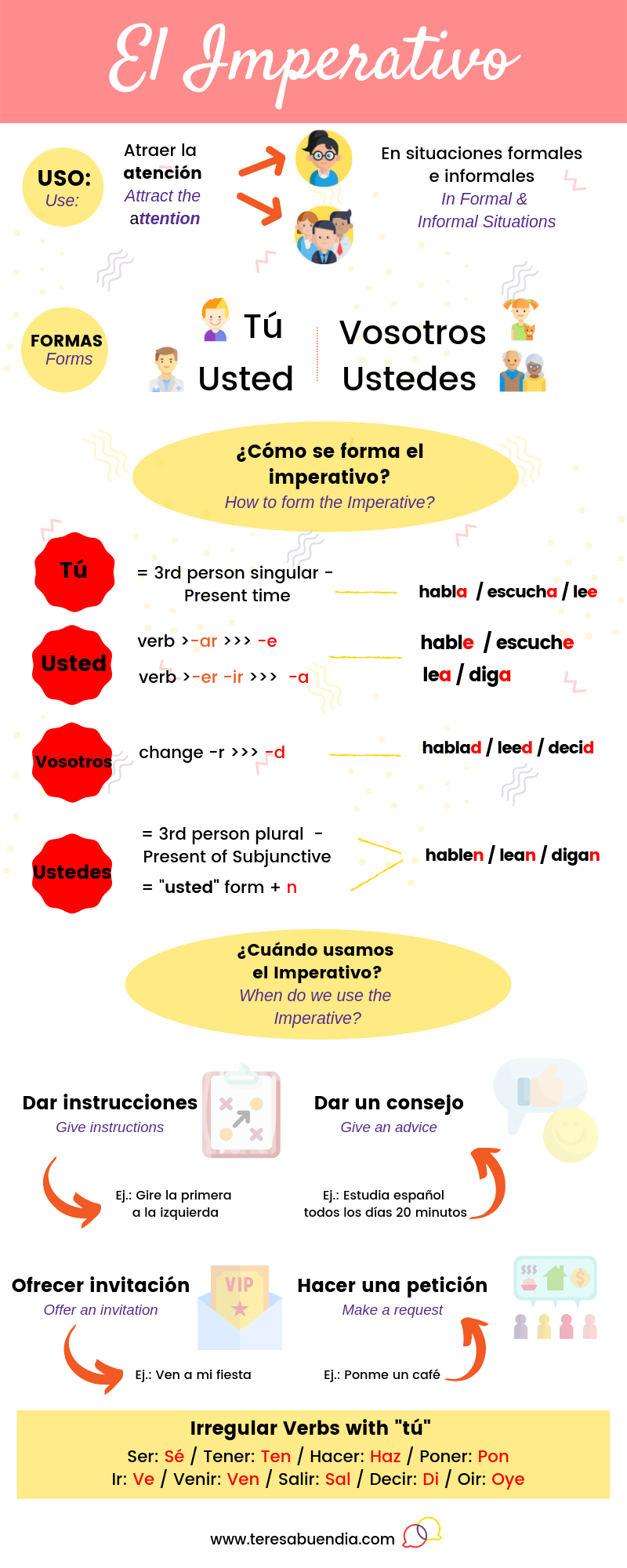
El imperativo
- ¿Para qué y cuándo utilizamos el Imperativo?
El Imperativo lo usamos para llamar la atención de una o más personas y se utiliza en situaciones tanto formales como informales.
For what and when do we use the Imperative?
We use the Imperative to attract the attention of one or more people and is used in both formal and informal situations.
2.¿Qué formas utilizamos en el Imperativo?
Las formas que utilizamos son 4: Tú / Usted / Vosotros y Ustedes.
What forms do we use in the Imperative?
The forms we use are 4: You / You / You and You. :)))
3.¿Cómo se forman los verbos para cada persona?
TÚ:
Para formar el Imperativo de la forma personal TÚ se utiliza el presente de indicativo en la 3ª persona del singular (él/ella/usted)
Ej. habla, corre, escribe…
To form the Imperative of the personal form YOU, we use the indicative present in the 3rd person of the singular (he / she / you)
VOSOTROS:
Para formar el imperativo de la forma personal VOSOTROS simplemente hay que suprimir la -r final del verbo en infinitivo para posteriormente añadir una -d.
Ej. Trabajar —— trabajad / vivir—– vivid
To form the imperative of the personal form VOSOTROS just have to eliminates the final -r of the infinitive and then add the letter -d.
USTED:
Para formar el imperativo de la forma personal USTED tendremos en cuenta lo siguiente:
- Los verbos que acaban en -AR cambian para -e. Ej. Amar — ame
- Los verbos que acaban en -ER / -IR cambian para -a. Ej. Escribir —- escriba
- Coincide con la primera persona del singular del subjuntivo. (Pero no te líes, si no has estudiado el subjuntivo ya lo verás más adelante)
To form the imperative of the personal form YOU will take into account the following:
- The verbs that end in -AR change to -e. Ej. Amar — ame
- The verbs that end in -ER / -IR change to -a Ej. Escribir —- escriba
- It also coincides with the first person of the singular of the subjunctive. (But do not worry, if you have not studied the subjunctive, you will see it later)
USTEDES:
Para formar el imperativo de USTEDES, puedes tener en cuenta lo siguiente:
- A la forma del imperativo de «usted» hay que añadirle una -n al final. Ej.: Bajen/Corran/Digan
- Coincide con la tercera persona del plural (ellos/ellas) del presente de subjuntivo.
To form the imperative of YOU, you can take into account the following:
- To the form of the “you” imperative, you have to add a -n at the end. Ej.: Bajen/Corran/Digan
- It coincides with the third person of the plural (they) of the present subjunctive.
4.¿Cuándo uso el Imperativo?
- Dar órdenes: Ej.: Baja la voz
- Dar instrucciones: Ej.: Sigue todo recto
- Dar consejos: Ej.: No llames a la puerta, se enfadará
- Hacer una petición: Ej.: Camarero, póngame un cortado
- Invitar: Ej.: Ven a mi casa a las siete
When do I use the Imperative?
- Give orders: Ex. Speak slowly
- Give instructions: Ex. Go straight.
- Give advice: Ex. Don´t knock the door, she will be angry.
- Make a request: Ex. Waiter, put me a “cortado” ( I know you can find it very abrupt, but in Spanish is not)
- Invite: Ex. Come to my house at seven
Vamos a ver la formación de los verbos regulares e irregulares con ejemplos:
We will see the formation of regular and irregular verbs with examples:
VERBOS REGULARES
| Persona | -ar (hablar) | -er (correr)* | -ir (escribir)* | |||
| + | – | + | – | + | – | |
| Tú | habla | no hables | corre | no corras | escribe | no escribas |
| Usted | hable | no hable | corra | no corra | escriba | no escriba |
| Vosotros | hablad | no habléis | corred | no corráis | escribid | no escribáis |
| Ustedes | hablen | no hablen | corran | no corran | escriban | no escriban |
*tienen las mismas terminaciones.
VERBOS IRREGULARES
| Persona | -ar (pensar) | -er (querer) | -ir (seguir) | |||
| + | – | + | – | + | – | |
| Tú | piensa | no pienses | quiere | no quieras | sigue | no sigas |
| Usted | piense | no piense | quiera | no quiera | siga | no siga |
| Vosotros | pensad | no penséis | quered | no queráis | seguid | no sigáis |
| Ustedes | piensen | no piensen | quieran | no quieran | sigan | no sigan |
| Persona | Estar | Ser | Oir | |||
| + | – | + | – | + | – | |
| Tú | está | no estés | sé | no seas | oye | no oigas |
| Usted | esté | no esté | sea | no sea | oiga | no oiga |
| Vosotros | estad | no estéis | sed | no seáis | oid | no oigáis |
| Ustedes | estén | no estén | sean | no sean | oigan | no oigan |
IRREGULARES TOTALES
Watch out for these verbs with the pronoun TU
|
Ser Tener Poner Hacer Salir Decir Venir Ir |
TÚ |
sé ten pon haz sal di ven ve |
VERBOS REFLEXIVOS
| Persona | Lavarse | Caerse | Ir (se) | |||
| + | – | + | – | + | – | |
| Tú | lávate | no te laves | caéte | no te caigas | ve, vete | no vayas
no te vayas |
| Usted | lávese | no se lave | cáigase | no se caiga | vaya, váyase | no vaya
no se vaya |
| Vosotros | lavaos | no os lavéis | caeos | no os caigáis | id, idos | no vayáis
no os vayáis |
| Ustedes | lávense | no se laven | caíganse | no se caigan | vayan
váyanse |
no vayan
no se vayan |
Espero que te sea útil.
Un abrazo,
Teresa